Komfort Auto Parts
Cleaning auto parts safely starts with knowing what the part is made of. A steel bracket can tolerate methods that may damage an aluminum housing, rubber seal, electrical connector, or painted surface. The right approach depends on the soil, the material, and the part’s job. Small details matter: a soft nylon brush, a lint-free cloth, and a tray that catches runoff can prevent scratches and mess.
This guide explains How to clean auto parts safely, from choosing a suitable cleaner to drying parts thoroughly before reassembly. Automotive cleaning expert [Name and credentials] offers this practical reminder: “[Insert a verified quotation about matching the cleaning method to the part’s material.]” Confirm the expert’s identity and wording before publication; an unsourced quote can undermine otherwise careful advice.
A clean part is not always a safe part. Hidden moisture, loosened coatings, or residue around a seal may cause trouble later. Wear suitable eye and hand protection, follow the product label, and work with good airflow. Keep cleaners away from heat and ignition sources. When a part’s material or coating is uncertain, pause and check the manufacturer’s guidance. It may feel slower. It is often the safer call.
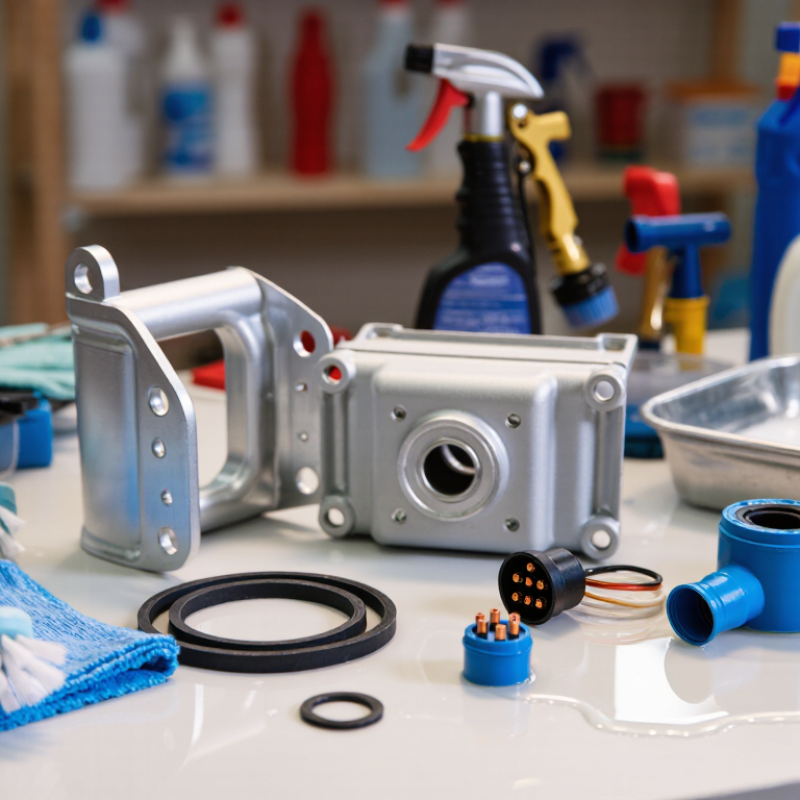
Before cleaning, identify the part’s metal, plastic, and seal materials. Aluminum can discolor or pit when exposed to highly alkaline cleaners; steel may tolerate different products, but trapped moisture can encourage corrosion. Look for molded plastic codes and inspect rubber seals for cracking or softness. A clear surface is not proof of compatibility. The U.S. Department of Energy’s Vehicle Technologies Office reports that reducing vehicle weight by 10% can improve fuel economy by 6–8%, reflecting the industry’s use of varied lightweight materials. That mix makes one-cleaner-fits-all a risky assumption.
Tips: Check the cleaner’s safety data sheet for material restrictions. Test a small, hidden area, then wait and inspect for swelling, fading, tackiness, or residue. Keep solvent away from seals unless the label confirms compatibility. Small details matter.
For a greasy steel bracket, use a compatible cleaner and a soft brush; rinse only if the product instructions allow it, then dry promptly. For aluminum housings or plastic connectors, choose a milder option and avoid soaking. If the material is uncertain, pause and consult the part documentation. I would not trust appearance alone: some damage shows up only after drying, and that easy shortcut can cost more later.
Before cleaning an auto part, check the current Safety Data Sheet for the exact solvent. OSHA lists acetone’s permissible exposure limit as 1,000 ppm over an eight-hour workday. That is a time-weighted average, not a safe target for every moment or every worker. A reading below the limit does not rule out irritation or other risks. Check the SDS exposure controls and your workplace requirements, too.
Set up the job in a well-ventilated area, away from flames, sparks, and hot surfaces. Acetone vapors can ignite. Use only enough liquid to wet a cloth or brush, and keep the container closed between uses. Wear gloves and eye protection specified by the SDS; material compatibility matters. Never clean parts in a closed garage and assume an open door is enough. It may not be.
The easy mistake is focusing on the part and forgetting the air around it. Pause if vapors build up or you feel dizzy or irritated, then move to fresh air and follow workplace procedures. Let the part dry fully before reassembly, and handle used cloths and leftover solvent as directed by the SDS. Sections 2, 8, and 10 can help identify hazards, controls, and incompatibilities. Sometimes the safest cleaner is a less volatile product suited to the part.
Choose a cleaning method based on the part material, the contaminant, and the product’s Safety Data Sheet (SDS). Use ventilation and follow the SDS even when a substance’s legal exposure limit appears high.
| Cleaning method | Suitable use | Key safety practices | Verified limit or guidance |
|---|---|---|---|
| Water-based detergent and manual washing | Grease and general grime on compatible metal or plastic parts. | Check material compatibility; wear eye protection and gloves selected for the detergent; collect contaminated wash water as required by local rules. | There is no single exposure limit for all detergents. Check the SDS for the specific mixture and its ingredients. |
| Enclosed aqueous parts washer | Repeated cleaning of compatible parts in a workshop. | Keep the lid closed during operation, maintain the equipment, and avoid skin contact with the cleaning solution. Follow the equipment and chemical SDS instructions. | Exposure limits depend on the cleaning solution; an enclosed system can help reduce splashes and vapor release. |
| Acetone-based cleaning | Small, specific cleaning tasks where the part and coating are confirmed compatible. | Use effective ventilation; keep away from flames, sparks, hot surfaces, and other ignition sources. Use gloves confirmed suitable by the SDS, and keep containers closed when not in use. | OSHA’s permissible exposure limit (PEL) is 1,000 ppm as an 8-hour time-weighted average. NIOSH recommends 250 ppm as a time-weighted average and 500 ppm as a short-term exposure limit. These limits are not a guarantee of zero risk. |
| Other solvent-based cleaners | Parts with contamination that water-based methods cannot remove, when the solvent is compatible with the part. | Read the product SDS before use. Do not assume different solvents have the same exposure limits, flammability, or glove compatibility; provide ventilation and control ignition sources when required. | There is no universal limit for “parts cleaner.” Use the limits and controls listed for the specific ingredients in the SDS. |
| Compressed air for drying or debris removal | Drying or removing loose debris when safer methods, such as wiping or vacuuming, are unsuitable. | Use effective chip guarding and appropriate eye and face protection. Never direct compressed air at a person or use it to clean clothing or skin. | OSHA generally limits compressed air used for cleaning to less than 30 psi, with effective chip guarding and personal protective equipment. |
| Waste handling and storage | Spent solvent, oily wipes, sludge, and contaminated wash materials. | Use compatible, closed, labeled containers; keep flammable waste away from ignition sources. Determine disposal requirements from the SDS and applicable local and environmental rules. | Waste classification depends on the material and contamination; do not pour solvents or oily cleaning waste into drains. |
Important: OSHA’s PEL is a legal workplace exposure limit, not a recommendation to work up to that concentration. Review the current SDS, assess the task and ventilation, and use appropriate controls. References: OSHA 29 CFR 1910.1000, NIOSH Pocket Guide: Acetone, and OSHA 29 CFR 1910.242(b).
Before cleaning auto parts, identify the actual hazard: brake dust, rust, degreaser, or solvent vapors. Read the product’s safety information and check whether old coatings or residues may create extra exposure. A NIOSH-approved N95 filters at least 95% of test particles when properly selected and fitted. It does not filter gases or vapors. That distinction matters when a strong-smelling cleaner is involved.
Match protection to the task. For dust, use a properly fitted N95 and keep the work area ventilated; avoid blowing residue into the air with compressed air. For solvent vapors, an N95 alone is not enough. The appropriate respirator and chemical cartridge depend on the product and exposure, so follow its safety guidance or consult a qualified safety professional. Use splash goggles and chemical-resistant gloves when liquids can reach your eyes or skin. It is easy to focus on the mask and miss a small splash.
Tips: Check the respirator seal each time you put it on, and keep facial hair away from the sealing edge. Replace damaged gloves promptly. If the cleaner’s odor persists or you feel irritation, stop, move to fresh air, and reassess the setup. The mask is only one part of safe cleaning.
A bright metal surface can still hide particles in a bore, thread, or narrow channel. ISO 16232 provides methods for assessing particulate cleanliness in road-vehicle components; it does not set one universal pass limit. The required cleanliness level should match the component’s function and the agreed acceptance criteria.
Testing begins with a documented extraction method. Depending on the part, particles may be removed by rinsing, flushing, agitation, or carefully controlled ultrasound. The extraction fluid and equipment must be clean, with blank tests used to check background contamination. The collected fluid passes through a membrane filter. Analysts can then measure particle mass, count particles, and assess their size. Microscopic examination can help identify particle shape or material when needed. Small details matter.
A reliable report records the part, extraction method, filter, and analysis conditions, alongside the results. This makes comparisons between production checks more meaningful. Keep cleaned samples protected during handling; a loose fiber from a glove or bench can change the result. A clean-looking part may still fail. I have to admit, visual inspection is an easy habit to trust too much. Use the ISO 16232 procedure consistently, and interpret findings against the component-specific limit—not appearance alone.
When cleaning auto parts, plan for solvent storage before opening the container. Use an OSHA-compliant safety can rated for the specific solvent, and keep each can’s capacity at no more than 5 gallons. Smaller amounts may be easier to handle. Never pour in more than the can is designed to hold.
Choose a can with a secure, self-closing lid and a clear label showing its contents. Keep the lid closed between uses, and inspect the can for dents, leaks, or a faulty closure. A quick check matters. Follow the solvent’s safety data sheet and the can manufacturer’s instructions, since materials and handling needs differ.
Keep cans away from sparks, hot surfaces, and other ignition sources, in a ventilated storage area approved for flammable materials. Don’t leave a can beside a parts-washing bench just because it is convenient. It is easy to focus on the cleaning task and overlook where the solvent sits afterward. Check applicable workplace and fire-safety requirements, too; a five-gallon limit does not replace safe storage practices.
Parts may combine metal, plastic, and rubber seals. One cleaner may not suit them all. Appearance can mislead.
It may discolor or pit aluminum. Use a milder option when compatibility is uncertain, and avoid soaking the part.
Read its safety information for material restrictions. Test a hidden spot, then inspect after drying for fading, swelling, tackiness, or residue.
Use a compatible cleaner and a soft brush. Rinse only if the instructions allow it, then dry the bracket promptly.
Pause and check the part documentation. Guessing from its appearance is tempting, but damage may appear only after drying.
No. It filters at least 95% of test particles when properly selected and fitted, but it does not filter gases or vapors.
Use splash goggles and chemical-resistant gloves when liquids could reach your eyes or skin. Respirator needs depend on the product and exposure.
Keep the area ventilated, and do not blow residue around with compressed air. Check the respirator seal each time. Small steps matter.
Stop cleaning and move to fresh air. Reassess the setup and follow the product’s safety guidance. I might overlook a small splash, too.
How to clean auto parts safely begins with identifying the materials involved. Metals, plastics, rubber seals, and coatings can react differently to cleaners, so choose a product compatible with every surface and test it on a small area when appropriate. Before using a solvent, review its safety data sheet for exposure limits, ventilation needs, and handling precautions. For example, the outline notes an OSHA 8-hour permissible exposure limit of 1,000 ppm for acetone; follow the product’s instructions and keep exposure as low as practical.
Select protective equipment according to the specific hazard. An N95 respirator can filter at least 95% of airborne particles, but it does not protect against solvent vapors, so it should not be treated as vapor protection. After cleaning, ISO 16232 test methods can help assess particulate cleanliness. Store solvents in suitable, labeled safety cans, keep containers closed, and observe the stated five-gallon storage limit.
